Collection: Sodalite Crystal Skulls

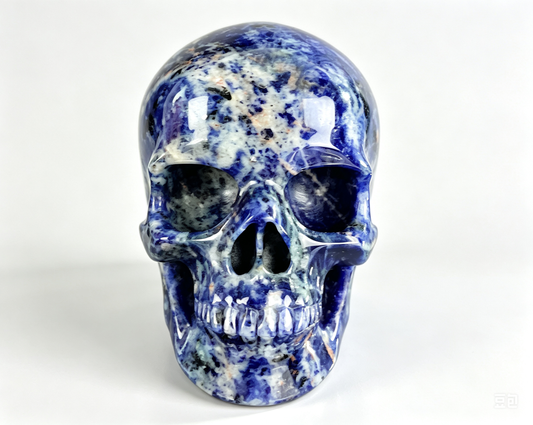
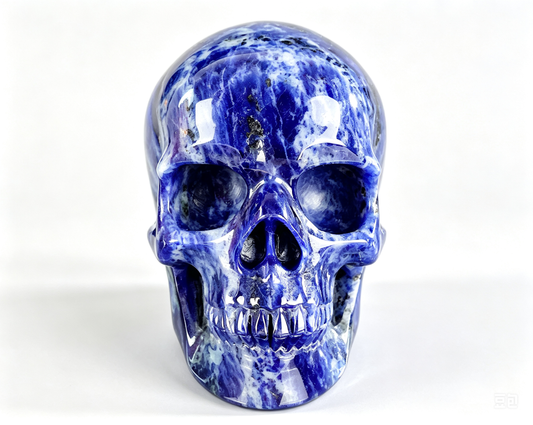
Sodalite crystal skulls hand carved from deep blue natural stone with characteristic white calcite veining. Each piece carries a calm, grounding appearance — a favorite among collectors drawn to blue gemstones.

Hand-Carved Art

Deep Blue with a Map Inside

Sodalite is a sodium aluminium silicate mineral that forms in alkaline igneous rocks. Its colour — a rich, opaque blue — comes from the chlorine and sulphur within its crystal structure, not from surface treatment or dye. What distinguishes it visually from most blue stones is the white veining that runs through nearly every block: these are patches of a related mineral called natrolite or calcite, intergrown with the sodalite during the same formation event. The blue and white are inseparable parts of the same rock.

Each skull is hand-carved from a single block of natural sodalite. The ratio of deep blue to white veining shifts across every block, which means no two skulls share the same pattern. Some pieces run predominantly blue with fine white threads; others carry broader white territories that interrupt and frame the colour. The irregular distribution is what makes sodalite instantly recognisable and impossible to replicate in cast or synthetic materials.

echo crystal

Frequently Asked Questions

How is sodalite different from lapis lazuli — they look similar?

Both are deep blue opaque stones, but they are different minerals with different compositions. Sodalite is sodium aluminium silicate; lapis lazuli is a rock composed primarily of lazurite, with pyrite flecks and calcite. The easiest distinction is the white patterning: sodalite has smooth white veins of calcite or natrolite running through it, while lapis lazuli typically shows golden pyrite specks and a more granular, multi-mineral texture. Sodalite also tends to be more uniformly blue without the golden flecks. All skulls in this collection are accurately labelled as sodalite.

What is sodalite associated with?

Within the crystal and spiritual community, sodalite is commonly linked to clear thinking, honest communication, and the calming of mental noise. It is frequently placed in work or study spaces and is associated with the throat chakra in chakra practice. These associations reflect beliefs held within that community and are not medically verified claims — sodalite is a decorative and collectible object, and any meaning it carries is personal.

The above reflects beliefs within the crystal healing community and is not intended as medical advice or a substitute for professional care.

How do I care for a sodalite skull?

Sodalite has a Mohs hardness of 5.5–6, which makes it moderately durable but susceptible to scratching from harder stones. Keep it stored separately from quartz-family stones, which can mark its surface. Wipe with a soft dry cloth; avoid prolonged water immersion as it can affect the white mineral inclusions over time. Keep out of direct, sustained sunlight — while sodalite is more stable than amethyst or rose quartz, extended UV exposure can gradually dull the depth of the blue.