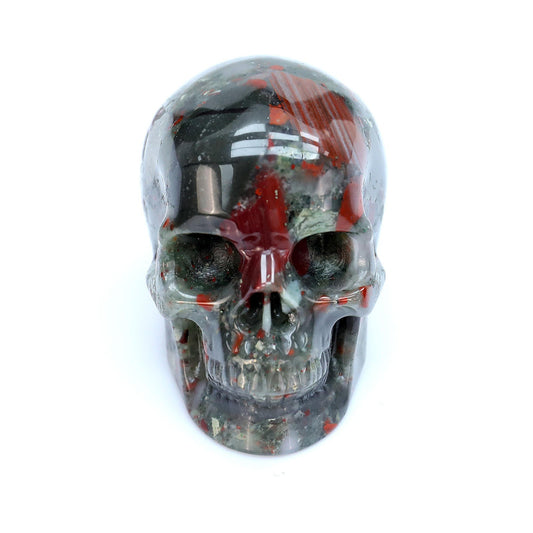
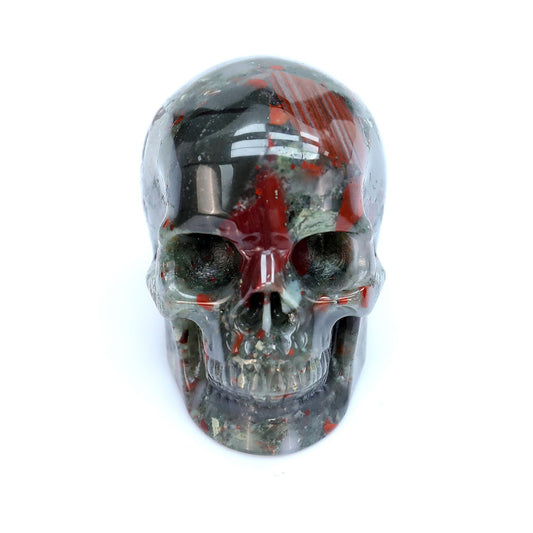
Collection: Blood Stone Crystal Skulls

Bloodstone crystal skulls hand carved from dark green chalcedony with characteristic red jasper inclusions. One of the oldest known gemstones used for carving, bloodstone carries centuries of protective symbolism. Each skull reveals a unique arrangement of green and red throughout the stone.

Green Stone, Red Marks

Bloodstone — also known as heliotrope — is a dark green chalcedony (microcrystalline quartz) speckled with red, orange, or yellow spots caused by iron oxide inclusions. The green base forms from chlorite or celadonite distributed through the chalcedony matrix, while the red spots develop where haematite or jasper concentrates in small pockets within the same rock. The two components form together in the same geological environment, producing a stone whose contrast is entirely natural and unrepeatable.

Each skull is hand-carved from a single block of natural bloodstone. The number, size, and placement of the red spots varies with every block — some pieces carry dense, scattered speckling across the whole surface; others concentrate the colour in one area while the rest reads as deep, uninterrupted green. Because the spots form in irregular deposits within the stone, the carving reveals wherever they happen to fall in that particular block, with no way to predict or control the result before cutting begins.

echo crystal

Frequently Asked Questions

Why do some bloodstone skulls have more red spots than others?

The red spots in bloodstone form where iron oxide concentrates within the chalcedony during the stone’s geological formation. This concentration is uneven and unpredictable — some sections of rock carry more haematite than others, and the carving simply reveals whatever is present in that block.

A piece with fewer spots is not inferior to one with many; both are natural bloodstone. The variation is part of what makes each skull a singular object. Product listings include close-up images to show the specific distribution on individual pieces where possible.

What is bloodstone associated with?

Bloodstone has one of the longest recorded histories of any gemstone used symbolically. In medieval Europe it was associated with sacrifice and renewal; in ancient traditions it was linked to vitality, courage, and physical endurance. Within the contemporary crystal community, it is commonly used as a grounding and protective stone, associated with the root chakra and with themes of strength and resilience. These associations reflect cultural history and community beliefs — they are not medically verified claims, and bloodstone is a decorative and collectible object.

The above reflects beliefs within the crystal healing community and is not intended as medical advice or a substitute for professional care.

How do I care for a bloodstone skull?

Bloodstone sits at Mohs 6.5–7, making it a durable display stone. It handles normal handling well and does not require special maintenance. Wipe with a soft dry or slightly damp cloth and dry promptly. Avoid chemical cleaners and prolonged soaking.

Unlike some stones in this collection, bloodstone is not particularly sensitive to sunlight and is stable in normally lit indoor spaces. Store individually to avoid chipping the carved detail against harder stones.